The Holy Quran places immense importance on the pursuit of knowledge. The divine message repeatedly stresses that education is a vital tool for personal and communal development. All Mighty Allah says in Surah Az-Zumar: قل هل يستوی الذين يعلمون والذين ﻻ يعلمون “…Are those who know equal to those who know not?” (Quran 39:9) Furthermore, Allah commands believers to continually seek knowledge in Surah Taha: وقل رب زدنی علماً “And say: ‘My Lord! Increase me in knowledge.’” (Quran 20:114) These verses reflect Islam’s emphasis on lifelong learning and the transformative power of education.

- Call Us: +15672810466
- Email:info@auliyacouncil.com
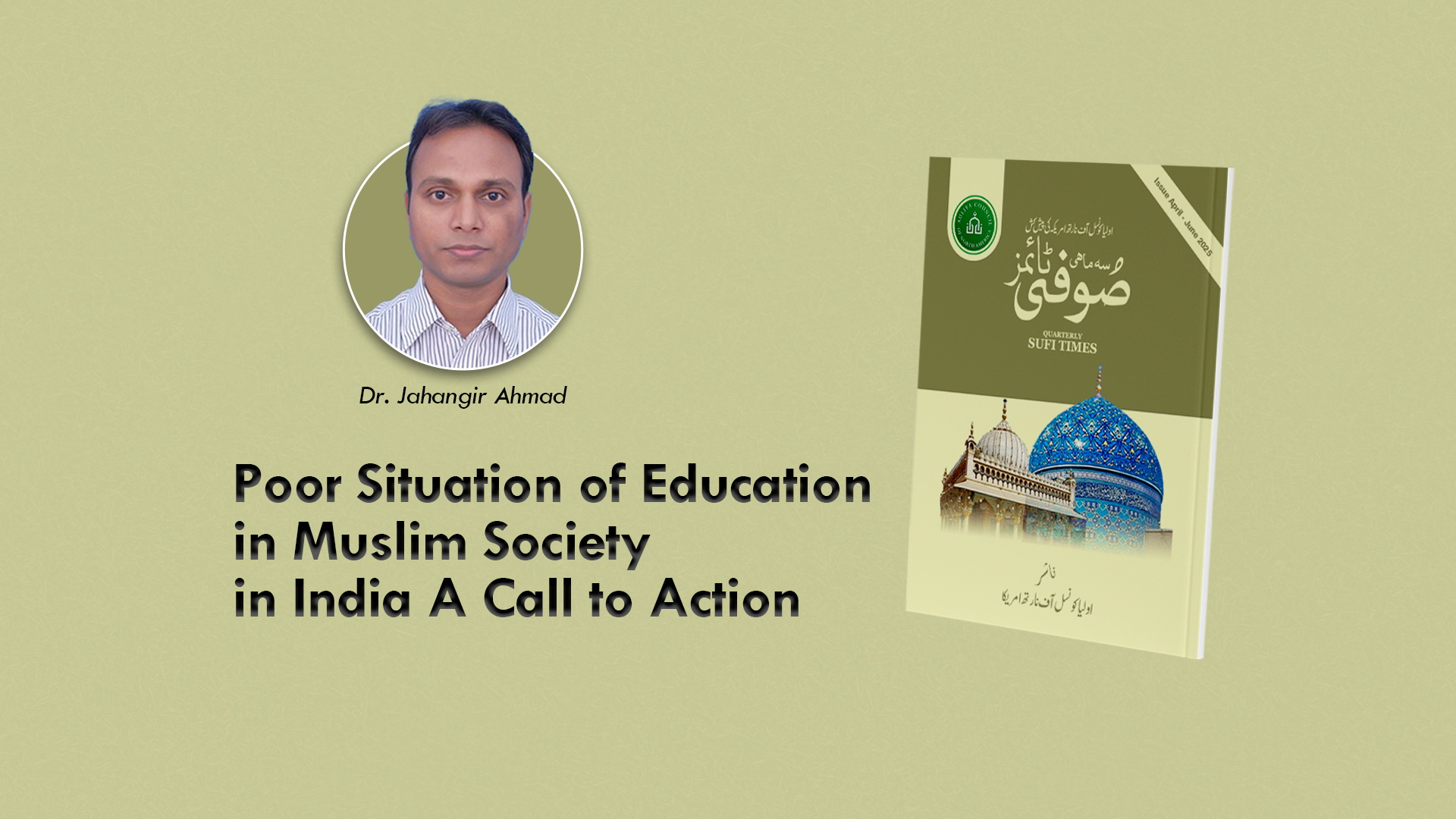
Poor Situation of Education in Muslim Society in India A Call to Action
Dr. Jahangir Ahmad
The educational status of Muslims in India paints a concerning picture. Despite the strong emphasis Islam places on acquiring knowledge, Muslim communities lag behind in literacy, socio-economic development, and access to quality education. According to the 2011 Census, the literacy rate among Muslims in India stands at 68.5%, significantly lower than the national average of 74%. The disparity is even more pronounced among Muslim women, whose literacy rate is only 53.2%. These statistics underscore the urgent need for introspection and action to address the educational crisis facing the community.
The Quranic Emphasis on Knowledge
The Teachings of Prophet Muhammad (PBUH) Emphasizing on Knowledge
Prophet Muhammad (PBUH) also underscored the importance of acquiring knowledge. He said: طلب العلم فريضۃ علی کل مسلم۔ “Seeking knowledge is an obligation upon every Muslim.” (Sunan Ibn Majah, Hadith 224) In another narration, the Prophet (PBUH) declared: “The ink of the scholar is more sacred than the blood of the martyr.” (Jami’ al-Tirmidhi) These teachings serve as a reminder of the critical role education plays in the spiritual and social uplift of individuals and communities.
Challenges Facing Muslim Education in India
Despite the religious emphasis on education, Muslims in India face several challenges that hinder their educational progress:
- Low Literacy Rates: The literacy rate among Muslims is below the national average, reflecting widespread educational deprivation. The gap is particularly stark among Muslim women, perpetuating gender inequality in education.
- Limited Access to Educational Institutions: Many Muslim-dominated regions lack quality schools, colleges, and universities. This lack of infrastructure limits opportunities for higher education and professional growth.
- Economic Marginalization: Economic deprivation among Muslims further exacerbates the issue. Poverty and financial instability make it difficult for families to prioritize education over basic survival needs.
- Stereotyping and Discrimination: Social and institutional biases against Muslims often lead to exclusion from mainstream educational opportunities, compounding the community’s challenges.
A Call to Action
Addressing these challenges requires a multifaceted approach involving community participation, institutional support, and policy interventions. Here are some key steps to consider:
- Establish Quality Educational Institutions
The Muslim community must prioritize the establishment of quality schools, colleges, and universities that cater to the educational needs of their children. These institutions should focus on providing modern education while retaining cultural and religious values. Public-private partnerships and community-based initiatives can play a pivotal role in this endeavor.
- Promote Literacy and Vocational Training
Literacy programs and vocational training initiatives are crucial for equipping individuals with skills to access better job opportunities. Emphasis should be placed on women’s education to bridge the gender gap and empower Muslim women.
- Foster Community Involvement
Community leaders, parents, and teachers must actively support educational initiatives. Encouraging parental involvement in children’s education can create a more supportive learning environment.
- Advocate for Government Support
The government must implement policies that address the unique challenges faced by Muslims in education. Special scholarships, reservation policies, and the inclusion of Muslim-majority areas in development schemes can help bridge the gap.
- . Combat Stereotypes and Discrimination
Efforts to challenge stereotypes and foster social harmony are essential. Media, civil society, and educational institutions must work to create an inclusive environ
ment where Muslim students feel valued and respected.
Conclusion
The Quran and Hadith emphasize the transformative power of education. For the Muslim community in India, recognizing the centrality of education is critical to overcoming socio- economic challenges and achieving progress. By establishing quality institutions, promoting literacy, and fostering community involvement, Muslims can chart a path toward empowerment and prosperity.
© Copyright 2024, All Rights Reserved By ACNA