
- Call Us: +15672810466
- Email:[email protected]
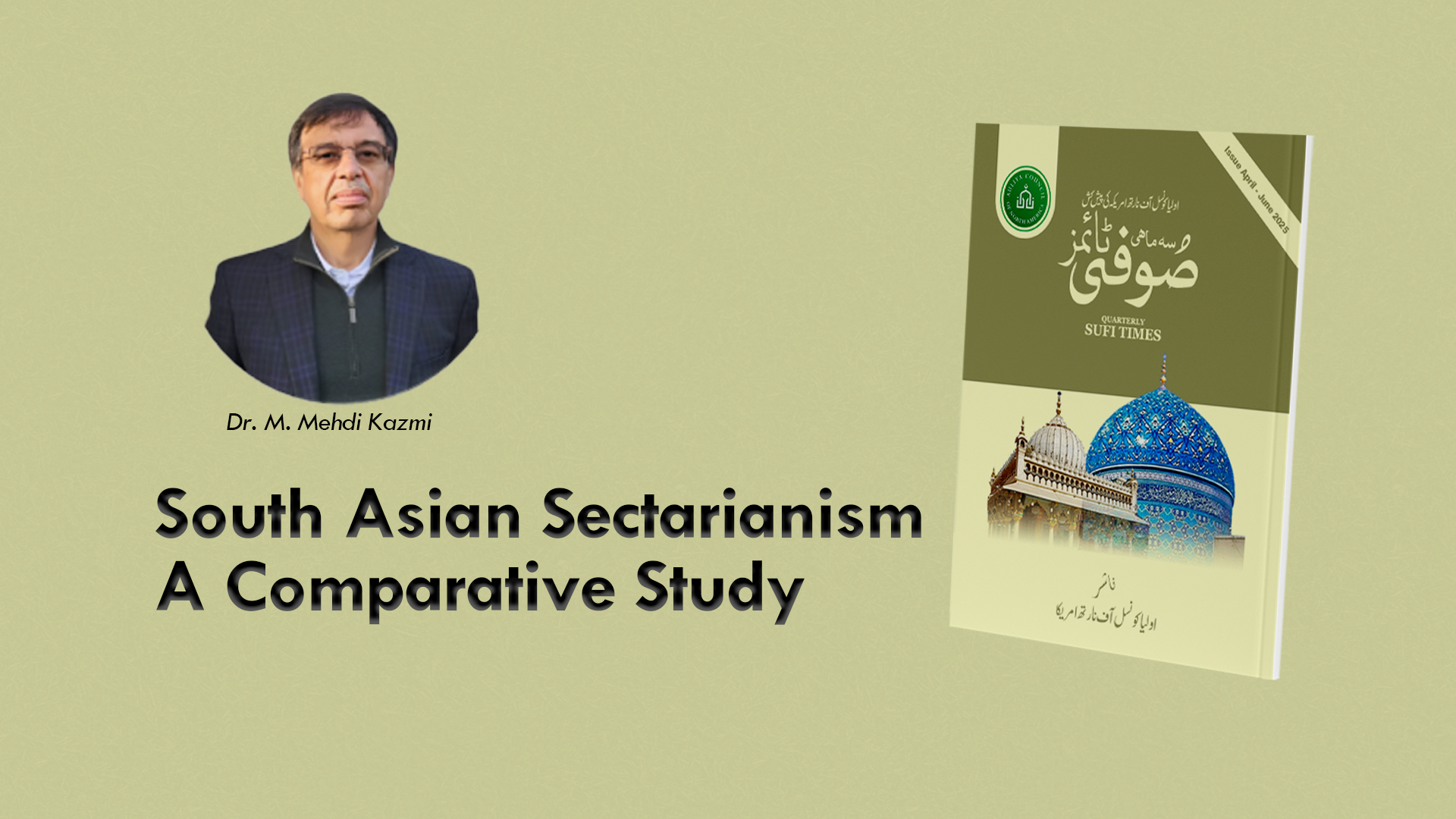
South Asian Sectarianism A Comparative Study
Dr. M. Mehdi Kazmi
- Sectarianism: A Wound in the Soul of the Subcontinent
In our beloved subcontinent, there exists an ailment so deeply entrenched that it has fragmented societies, fractured the collective soul, and made us a spectacle of ridicule before the world. This disease is sectarianism. What was meant to be a beautiful and unifying religion—Islam, with its profound message of justice, mercy, and brotherhood—has too often been reduced to bitter sectarian identity wars.
Each group insists that theirs is the “rightful sect” and the truest interpretation of Islam, even though most adherents possess little more than a superficial understanding of their own sectarian narrative. Why, then, do people cling so fiercely to these fractured identities? For some, it is a search for safety within the crowd, a way to ease the vulnerability of standing alone. For others, it is a refusal to acknowledge the legitimacy of how others believe and live. Sectarian affiliation can feed narcissism, turning sect leaders and heroes into objects of near – worship, revered as holier than all others. It can also provide a false sense of pride, a fragile identity propped up by declaring others inferior or misguided.
At its root, sectarianism panders to a primitive and destructive need simply to belong—at all costs. This unchecked need fuels hatred and enmity. Hate-mongering becomes a sport, a tool of manipulation, and an exercise of unrestrained power in the hands of those who thrive on these jungle-law narratives. The result is a society torn apart, where the richness of Islamic heritage is obscured by petty rivalries, and the spirit of unity is sacrificed at the altar of sectarian pride.
- The Need for Comparison
To compare and contrast who we are in relation to the Other is a natural human tendency. Human beings make sense of themselves by seeing themselves mirrored, challenged, or complemented in others. This comparative instinct becomes particularly vivid in societies marked by plurality—whether of religions, sects, or cultures. The South Asian subcontinent, home to vibrant Muslim communities of diverse orientations, offers fertile ground for such comparative work.
In my course on Interreligious Studies, I encountered an article in Understanding Religion: Theories and Methods for Studying Religiously Diverse Societies (Tweed & Fitzgerald, 2021). It describes a scholarly method of comparing religions in ways that are fair, empathetic, and illuminating. I realized that this same methodology could be applied to the study of sects. Too often, sectarian comparison is undertaken with an agenda—to assert superiority, delegitimize the Other, or fortify a sense of collective pride. Such approaches only deepen divisions. A more reflective and scholarly approach allows us to view sects not as battlegrounds for proving rightness but as distinct expressions of Islam, each with its own rich colors and profound ways of creating meaning.
- Rethinking the Concept of “Sect”
The very word sect often carries negative associations—fragmentation, schism, division. Yet, as Byron Earhart (1993) argued in Religious Traditions of the World, religion itself may be defined as a distinctive set of rituals, beliefs, doctrines, institutions, and practices through which members of a tradition establish, maintain, and celebrate a meaningful world. If we borrow this definition, sect can be rehabilitated as well.
A sect may not be a religion in and of itself, but it functions as a mode of expression within the larger religious tradition. It provides rituals and doctrines, structures of authority and institutions, ways of experiencing and embodying faith, and above all, a coherent worldview that addresses life’s enduring questions.
Here we might follow Lewis R. Rambo (1993) and Ninian Smart (1998), who understood religion as worldview. Smart outlined six key dimensions: doctrinal/philosophical, mythic/narrative, ethical/legal, ritual/practical, experiential/emotional, and social/institutional. When applied to sects, these categories reveal how each group within Islam develops its own balance of emphases. Some may privilege ritual and law, others experience and devotion, others authority and leadership. The task of comparative sect studies, therefore, is to notice these emphases, analyze them carefully, and understand their meaning for adherents.
- The Challenge of Comparison
Comparative study of sects has long been central to Islamic scholarship, but it also invites criticism. Jonathan Z. Smith (1990) warned that careless comparisons become “magical acts” that conjure false similarities, flattening distinct traditions. Yet comparison is unavoidable: human beings always understand the unfamiliar in light of what they already know. The challenge is to compare responsibly—attending both to similarities and to differences.
As Paul Hedges (2021) argues, meaningful comparison requires a balance of comparison and contrast. Overemphasizing patterns, as earlier scholars such as Mircea Eliade (1959) often did, risks erasing the distinctiveness of sects. Responsible comparison looks beyond doctrines alone and attends to lived practice—rituals, behaviors, institutions, and the cultural worlds in which sects are embedded.
- Comparative Glimpses: Deobandi, Barelvi, and Shia Traditions
Applying these principles to Deobandi, Barelvi, and Shia sects reveals both shared frameworks and profound divergences. All three draw from the Qur’an, Sunnah, and Islamic history, yet each has developed unique ways of understanding authority, salvation, ritual life, and identity.
- Deobandi: Emphasizes purification and austerity. Doctrines stress strict tawḥīd and avoidance of bidʿa (innovation), grounding themselves in Hanafi jurisprudence and rigorous madrasa scholarship. Rituals are simple—mosque prayers, Qur’an study, and avoidance of practices seen as corruptions, such as shrine visitation or musical devotion. The culture reflects sobriety and reform, shaped by resistance to colonial modernity (Metcalf, 1982).
- Barelvi: Affirms Sufi cosmology and devotional practices. Beliefs include the Prophet’s spiritual presence (ḥāḍir o nāẓir), the intercession of saints, and ongoing miracles of the unseen world. Rituals are rich and embodied: mawlid celebrations, ʿurs festivals, shrine visitations, devotional poetry (naʿat), and Qawwali. Barelvi culture is deeply tied to South Asian folk traditions, music, and poetry, with shrines serving as spiritual and social centers (Sanyal, 1996).
- Shia: Distinct in its doctrine of the Imamate. Shia Muslims affirm that divinely guided Imams from the Prophet’s family are the rightful leaders of the community, sinless and authoritative interpreters of faith. Rituals focus on memory and mourning, especially ʿAshura commemorations of Imam Husayn, Arbaʿeen pilgrimages, majlis gatherings, and matam (ritual chest-beating). Shia identity is profoundly shaped by Karbala, giving rise to a theology of sacrifice, resistance, and justice. Its culture is transnational, sustained by law, philosophy, poetry, and dramatic re-enactments (taʿziya) (Pinault, 1992; Hyder, 2006).
- Comparative Insights
Using Hedges’ comparative lens, several insights emerge:
- Authority: Deobandis trust texts and scholars; Barelvis extend authority to saints and the Prophet’s spiritual presence; Shias locate authority in the lineage of Imams.
- The Human Problem: Defined variously as innovation (Deobandi), forgetfulness of devotion (Barelvi), or injustice and betrayal (Shia).
- Salvation: For Deobandis, it lies in purification of practice; for Barelvis, in intercession and devotion; for Shias, in loyalty to the Imams and participation in the memory of Karbala.
Comparison shows that while all three sects affirm Islam’s shared foundations, they embody them in profoundly different ways. Outward similarities—communal gatherings, commemorations, recitations—mask very different functions: Deobandis seek to protect orthodoxy, Barelvis to cultivate love and intercession, and Shias to embody justice and sacrifice.
- Conclusion
In the end, comparison of sects, when done critically, is not about collapsing differences into sameness. It is about appreciating the distinct worlds of meaning each sect creates, while recognizing the broader human search for truth, justice, and devotion. To compare Deobandi, Barelvi, and Shia traditions responsibly is to see both their common Islamic heritage and their unique responses to enduring questions of authority, mediation, and the path to God.Far too often, our sectarian leaders expend their energies in spewing venom at one another, mistaking hostility for strength and aggression for a shallow performance of manliness. Their self-styled glorification, cloaked in bizarre titles, betrays a striking absence of training, scholarly engagement, or even the slightest inclination toward understanding the Other. In a culture of exaggerated hero-worship, so prevalent across the Subcontinent, followers readily align themselves behind these combative figures, addressed as “Hazrat this” or “Hazrat that,” without critical reflection.
It is incumbent upon all of us—leaders and followers alike—to cultivate the discipline of learning from and about other sects, other traditions, and other worldviews. The world does not, and cannot, revolve solely around the narrow orbit of one’s sectarian identity or leadership. To recognize that their self-righteous posturing is not the mantle of the Prophet ﷺ, but in fact a negation of his message and mission, is a realization that can only emerge through genuine encounter with the breadth and richness of other communities. Such engagement requires openness of heart and clarity of mind, guided by thoughtful method rather than impulsive hostility, and by the desire to learn rather than the compulsion to denounce.
© Copyright 2024, All Rights Reserved By ACNA