
- Call Us: +15672810466
- Email:info@auliyacouncil.com
Everyone recognizes the truth and understands what is just; the difference lies in this only a few choose to stand by it, while most do not.
In the Islamic understanding, God’s relationship with humanity is founded upon a primordial covenant known as al-Mīthāq—a covenant established with all the descendants of Adam. This covenant affirms that every human being is born with an innate recognition of God’s Lordship, an awareness embedded within human nature itself. The Qur’an gives this covenant explicit expression: “And remember when your Lord took from the children of Adam, from their loins, their descendants, and made them testify concerning themselves, ‘Am I not your Lord?’ They said, ‘Yes, we testify’” (Qur’an 7:172). This innate recognition is known as fitrah, the natural disposition through which no human being can claim complete ignorance of God. It is not acquired through culture, instruction, or history; rather, it precedes them all, forming the moral and spiritual foundation of human consciousness.
The nature of this covenant is neither political nor tribal. It is fundamentally spiritual and ethical, rooted in responsibility rather than privilege. God’s side of the covenant consists of guidance through prophets and revelation, mercy through repentance, and the promise of reward grounded in justice. Human beings, in turn, are entrusted with obligations: tawḥīd, the affirmation of divine unity; obedience to divine guidance; moral conduct anchored in justice, honesty, and compassion; and full accountability for one’s own actions. Justice, in this sense, is not merely a social arrangement or legal construct, but the lived expression of faith itself—the safeguarding of promises, equity, and moral balance in human affairs.
This covenant was reaffirmed repeatedly throughout history by successive prophets, each renewing humanity’s awareness through revelation, moral law, and social reform. With the advent of the Prophet Muhammad ﷺ, the covenant reached its final and universal articulation. The Qur’an stands as the last preserved guidance, and the moral framework of Islam defines how the covenant is to be lived both individually and collectively. Yet this was never meant to be a passive or purely intellectual faith. It demanded conviction—not the comfortable, insulated faith of quiet debates and inherited rituals, but a faith capable of drawing clear moral boundaries, confronting injustice, and reshaping societies. It required an idea sharp enough to distinguish truth from falsehood and powerful enough to compel action, even at the cost of life itself.
Central to this vision is the principle of personal responsibility. Each individual stands before God accountable for their deeds, without inherited guilt or delegated righteousness. No authority can absolve wrongdoing, and no lineage can substitute for moral action. The covenant is therefore lived not only through belief, but through conscience and conduct.
It is within this ethical and theological framework that Imam Ḥusain ibn ʿAlī emerges as a pivotal figure in moral history. His stand represents the embodiment of the individual covenant—the refusal to allow injustice to masquerade as religious legitimacy. Imam Ḥusain was not merely a historical actor responding to political circumstances; he was a revolutionary conscience, demonstrating that fidelity to the covenant may demand resistance when power abandons justice. Through his stand, the covenant was not redefined, but rescued from erasure.
The Qur’anic vision of covenantal life finds its social expression in Islam itself—not simply as a faith tradition, but as a civilizational principle. The Prophet Muhammad ﷺ emerged in a world profoundly fractured. Tribal Arabia was locked in cycles of violence, while the great neighboring empires—the Byzantine and the Sassanian—were exhausted, decaying, and morally hollow. The Near Eastern world had become a landscape of collapsed centers and fractured civilizations. Peace, where it existed, was not a solution but a symptom of exhaustion.
The Prophet recognized this breakdown as a manifestation of humanity’s failure to uphold its covenant with God. His response was neither withdrawal from the world nor conquest for its own sake, but the articulation of a moral system—rooted in the Qur’an and Sunnah—that translated the covenant into lived justice, peace, and social stability. Only within such a framework, he taught, could moral, political, and economic progress genuinely occur. Human history, viewed through this lens, is the story of humanity’s repeated struggle to honor or abandon this covenant. Progress is not merely technological or material; it is ethical and relational. As human beings develop ideas, institutions, and systems through their God-given will, true advancement occurs only when these creations align with justice, equity, and the well-being of all creation—human and non-human alike.
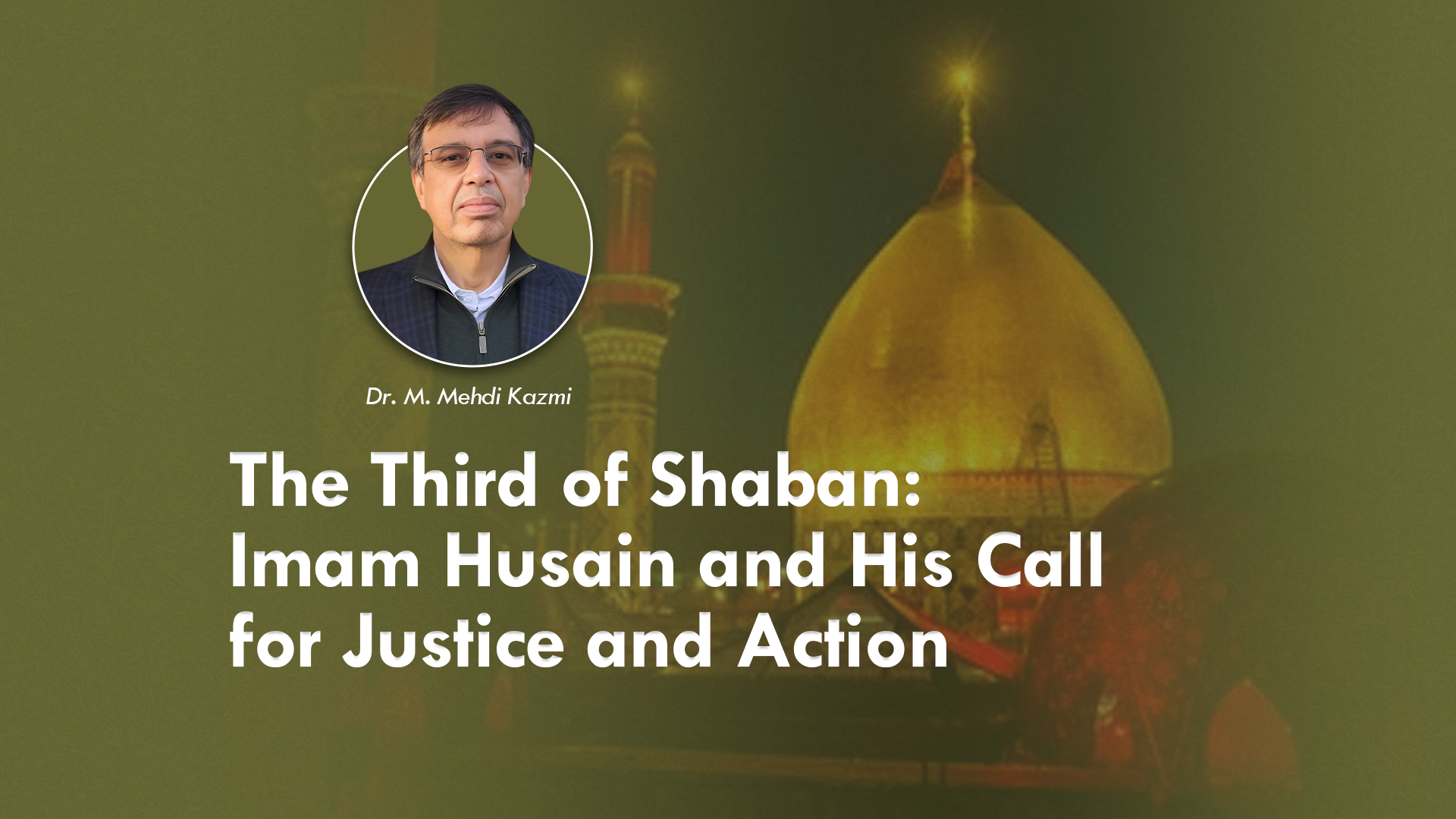
As the third of Shaʿbān—the birth anniversary of Imam Ḥusain—approaches, it becomes incumbent upon us to reawaken this revolutionary covenantal consciousness. Imam Ḥusain’s entire journey—from Medina to Mecca, from Mecca to Karbala, and into the moral afterlife of Karbala—must be understood not as a political rebellion nor as a tragic sacrifice in the conventional sense, but as a conscious and principled act to preserve the covenant between God and humanity. At its core, Karbala was not a battlefield; it was a theological and ethical reckoning.
Any political authority that demanded obedience at the cost of this covenant was, by definition, illegitimate—regardless of its claims to power. It was precisely this line that Yazid ibn Muʿāwiya crossed. His demand that Imam Ḥusain offer bayʿah, an oath of allegiance, was not a mere request for political loyalty; it was an attempt to secure religious legitimacy for a system grounded in injustice, coercion, hereditary absolutism, and moral corruption. Had Imam Ḥusain acquiesced, tyranny would have been sanctified as an Islamic norm, and the covenant between God and the Muslim community would have been effectively annulled.
Imam Ḥusain understood this with absolute clarity. His refusal was neither emotional nor impulsive; it was juridical, moral, and theological. He did not rise to seize power, nor did he view his stance as a heroic self-sacrifice. Rather, he regarded it as an inescapable duty owed to God. In this sense, Karbala was not chosen—it was imposed by fidelity to the covenant.
This understanding is reflected in the words attributed to him in his final moments: “O God, I have fulfilled my obligation to You. Now fulfill Yours.” This was not despair, nor a plea for personal salvation. It was a declaration that the human side of the covenant had been upheld at the highest possible cost, and that the preservation of Islam itself was now entrusted to divine justice.
To describe Karbala merely as a “battle” is therefore profoundly misleading. There was no contest of armies in any meaningful sense, nor a struggle for territorial gain. What occurred was the public exposure of injustice, the deliberate refusal to legitimize false authority, and the establishment of an eternal moral distinction. Imam Ḥusain did not fight to win; he stood so that truth would not die silently.
Had this stand not occurred, the very idea of resistance within Islam would have been extinguished. Injustice would have been absorbed into religious normativity, and submission to tyranny would have been mistaken for obedience to God. Humanity itself would have suffered a permanent moral deficit, as the right to say no to illegitimate power would have been erased from the moral imagination.
In the post-Karbala world, human societies continue to oscillate between two paradigms. One is the Hussaini paradigm: a commitment to justice, dignity, equality, moral courage, freedom of conscience, and the sanctity of human will. It does not promise comfort or safety; it demands responsibility. Opposed to it is the Yazidi paradigm, in which tyranny is disguised as order, domination is rationalized as stability, and religion is weaponized to silence conscience.
The contemporary Muslim world, fragmented and unstable, bears painful witness to the consequences of abandoning the Hussaini ethic. In this sense, the Hussaini idea is not merely a historical memory or sectarian symbol. It is the last remaining moral instrument for genuine human progress. It affirms that faith without justice is hollow, that power without ethics is illegitimate, and that silence in the face of oppression is itself a breach of the covenant.
Karbala is not a memory to be mourned; it is a principle to be lived. It affirms the uncompromising truth that sovereignty belongs to God alone, and that all human power is legitimate only insofar as it serves justice, dignity, and moral accountability. Imam Ḥusain’s stand was not a quest for rule, but a conscious refusal to sanctify tyranny, completing the prophetic ethic that denies absolute authority to kings, dynasties, and coercive systems.
Wherever this principle is abandoned, societies decay; wherever it is embraced, resistance becomes fidelity rather than rebellion. In this light, Karbala transcends geography, religion, and time. It speaks to every context in which human will is suppressed and moral truth is silenced. Resistance to injustice is not rebellion against order, but fidelity to divine sovereignty.
Let us therefore renew our commitment to the governance of God—not as a slogan, but as an ethical obligation. Let us recognize that the human will, gifted by the Divine, carries responsibility as well as freedom. And let us pray that this will is not merely acknowledged, but activated—in thought, in conscience, and in action.
The call to action, therefore, is neither abstract nor symbolic. It is a concrete moral obligation to stand unwaveringly for equality, justice, and peace, and to resist every manifestation of tyranny—whether the tyranny of distorted ideas that silence conscience, the tyranny of unchecked authority that erodes accountability, or the political, cultural, and economic systems that normalize inequality and perpetuate injustice. This resistance is not merely oppositional, nor confined to public protest or historical remembrance; it begins within the individual conscience and extends outward into collective responsibility. To oppose injustice in all its forms is to affirm the dignity of the human will as Entrusted by God, and to refuse complicity in structures that degrade truth and humanity. Only through such principled commitment—sustained in thought, action, and moral courage—do individuals and societies fulfill their side of the covenant with God, preserving the sacred balance between faith and justice upon which both spiritual integrity and human progress depend.
© Copyright 2024, All Rights Reserved By ACNA