
- Call Us: +15672810466
- Email:info@auliyacouncil.com
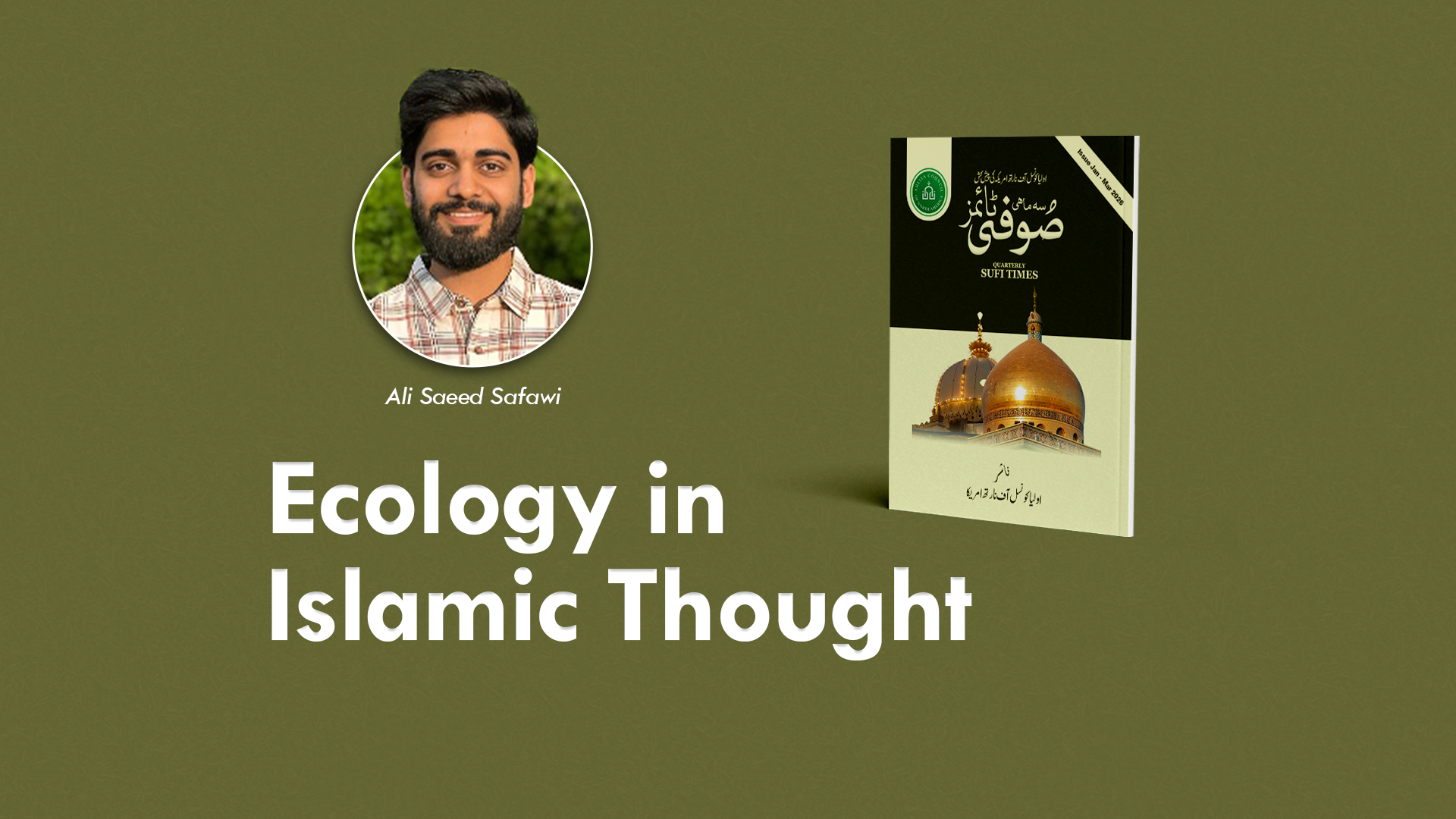
The contemporary ecological crisis has forced religious traditions to revisit their foundational sources and ask what resources they offer for imagining a just and sustainable relationship between humans and the natural world. Islam, as a scriptural and legal tradition with a long intellectual history, contains a rich vocabulary for thinking about nature, responsibility, and moral limits. Far from being indifferent to environmental concerns, Islam’s central concepts such as divine unity, human stewardship, balance, and justice can be reread today as an ethical framework that speaks directly to questions of ecology and environmental responsibility. This article offers a synthetic overview of how key Islamic ideas might inform an ecological ethic today. It does not claim to reproduce any one scholar’s argument, but instead sketches a broad, constructive picture of how Qur’anic theology, prophetic practice, and legal reasoning together generate a distinctive way of imagining nature and human action within it.
Normative sources and their character
Islamic reflection on nature and ecology begins with the normative sources of the religion: the Qur’an, the sayings and practices of the Prophet Muhammad, and the legal-ethical tradition known as fiqh. The Qur’an is not a systematic treatise on law or environmental policy; it is a revelatory discourse whose meaning emerges through careful interpretation, imaginative engagement, and communal reflection. Its verses move across multiple registers metaphysical, natural, and moral so that discussions of the cosmos, divine attributes, and human conduct are constantly intertwined rather than separated into different disciplines.The prophetic reports, while compiled later and often framed around practical questions of ritual, social order, and governance, preserve concrete examples of how the earliest Muslim community understood land use, water rights, animal welfare, and protection of certain spaces. Over time, jurists working with these materials developed more systematic legal categories such as land classifications, rules concerning water and pasture, or the designation of protected zones that embed environmental concerns within a broader framework of social justice and public welfare.
Qur’anic vision of nature
In the Qur’an, nature is neither a random collection of objects nor a mere backdrop to human drama; it is a coherent, ordered system governed by stable patterns that are repeatedly associated with divine command. Mountains, rivers, winds, plants, animals, and sky are described as functioning according to regular laws, which makes the world intelligible and invites humans to observe, reflect, and learn. Natural phenomena thus become signs that point beyond themselves, indicating both the wisdom of the creator and the moral order embedded in the fabric of existence.
At the same time, the Qur’an insists that nature does not contain within itself the ultimate ground of its own being; it exists because it has been brought into existence and sustained by a reality beyond it. This double emphasis on the regularity of natural processes and on their dependence upon a higher source produces a kind of theistic naturalism: the world is lawful and coherent on its own level, yet always transparent to a transcendent meaning that it cannot fully contain. The result is that studying nature, benefiting from it, and working within it are not acts opposed to religion but can themselves be modes of responding to divine signs.
Human beings as trustees
Human beings occupy a distinctive position in this Qur’anic picture. Humanity is described as honored among creatures and endowed with special capacities of intelligence, language, and moral responsibility, yet this exalted status is framed in terms of burden rather than privilege. The scriptural language of “trust” and “vicegerency” (khilāfah) portrays humans as bearers of a responsibility that other elements of creation declined to carry, precisely because of its weight. To say that the human being is a trustee is to say that the natural world does not belong to humanity in an absolute sense; dominion lies with the
creator, while humans act as stewards who must answer for how they use what has been entrusted to them. This trusteeship is tied to a primordial covenant, in which the human creature acknowledges its dependence upon and accountability to the divine, and thereby accepts limits to its own claims over the earth and its resources. The Qur’an connects the violation of these limits to the broader theme of corruption on earth, warning that human actions can disturb a cosmic balance that is otherwise characterized by proportion and order.
Balance, measure, and justice
A recurring Qur’anic motif is that everything in the universe has been created “in due measure” and according to a “balance.” This language of measure and balance operates on more than one level: it captures the idea of physical regularities in nature, but it also expresses a moral structure woven into the cosmos. Natural law and moral law are not unrelated; injustice, greed, and uncontrolled desire ultimately manifest as disruptions of the wider order within which humans find themselves.From this perspective, environmental degradation is not only a technical or economic problem but a symptom of a deeper ethical failure. When humans act without regard for limits over-exploiting land, polluting air and water, or destroying habitats they are not only harming other creatures but doing violence to themselves, because they are participants in the very system they damage. Classical Islamic discourse sometimes expresses this idea through the notion of “wronging oneself,” suggesting that wrongdoing inevitably comes back to hurt you by destroying the conditions you need to flourish.
Prophetic practice and early norms
Although the Prophet of Islam did not face climate change or industrial pollution in the modern sense, reports about his practice suggest an attitude toward the environment shaped by restraint, mercy, and concern for public welfare. Traditions dealing with water use, for example, emphasize avoiding waste even when resources appear abundant and stress equitable access to shared sources such as wells and streams. Reports about animals highlight prohibitions against cruelty, needless killing, or using living creatures merely as targets for entertainment.Early Muslim authorities created special protected areas where people were not allowed to overuse land, water, or wildlife. They did this to make sure natural resources would last. These protected zones, explained through Islamic legal rules, show that the community was willing to give up some private or short‑term benefits in order to protect long‑term environmental and social well‑being. Even though these ideas were formed long ago, they still give us useful language for talking about environmental protection, shared resources, and responsible management today.
Modern context and challenges
Today’s environmental crisis has developed within a global system shaped by modern science, industry, and colonialism. Many Muslim‑majority countries now use economic and social systems that came from outside and were often forced onto them. These new systems changed local traditions and weakened older, more balanced ways of living with the land and natural resources. Because of this modern situation, Islamic teachings about the environment cannot simply repeat ideas from the past. They must now deal with new realities like advanced technology, greater inequality, and new types of environmental danger that did not exist before.At the same time, there is a lively discourse within contemporary Muslim thought about how to respond. Some voices emphasize recovering neglected aspects of the tradition,such as humility before nature, restraint in consumption, and the spiritual significance of the created world.Others explore how concepts like stewardship, trust, and justice might inform policy debates on issues such as climate change, deforestation, and urbanization. Across these approaches, the underlying conviction is that Islamic sources offer more than general spiritual comfort; they can ground concrete ethical and legal responses to environmental degradation.
Toward an Islamic ecological ethic
Drawing these strands together, an Islamic ecological ethic would likely rest on several interrelated convictions. First, nature is meaningful: it is not merely raw material for human projects but a realm of signs that discloses wisdom, order, and mercy. Second, humans are both privileged and bound: endowed with special capacities, but obligated to exercise them within the limits set by trust, answerability, and respect for the larger balance of creation. Third, justice is inseparable from ecology: the way resources are distributed, the communities that bear environmental burdens, and the species pushed toward extinction are all ethical questions, not merely technical ones. Fourth, knowledge of natural processes is encouraged, not discouraged, because understanding the lawful patterns of the world is part of reading the signs embedded in creation and thus, a dimension of religious responsibility. From these starting points, concrete principles such as avoiding waste, protecting the vulnerable, preserving biodiversity, and prioritizing long-term communal welfare over short-term gain can be articulated in explicitly Islamic terms. Allah says: “And the heaven He raised and established the balance, so that you may not transgress the balance.” (Qur’an 55:7–8)
Conclusion
Islam’s foundational sources do not present a ready‑made environmental policy, but they do offer a coherent set of images, concepts, and values that can inform a contemporary ecological ethic. By emphasizing divine ownership, human trusteeship, cosmic balance, and the inseparability of justice from the natural order, the tradition invites Muslims to see environmental responsibility as an integral part of living faithfully rather than an optional, external concern.For scholars, activists, and communities seeking to respond to ecological crisis from within an Islamic framework, the task is both interpretive and practical: to reread the tradition in light of present realities, and to translate its insights into institutions, habits, and policies that honor the trust of stewardship over the earth.
© Copyright 2024, All Rights Reserved By ACNA