
- Call Us: +15672810466
- Email:info@auliyacouncil.com
Dr Afra Jalabi
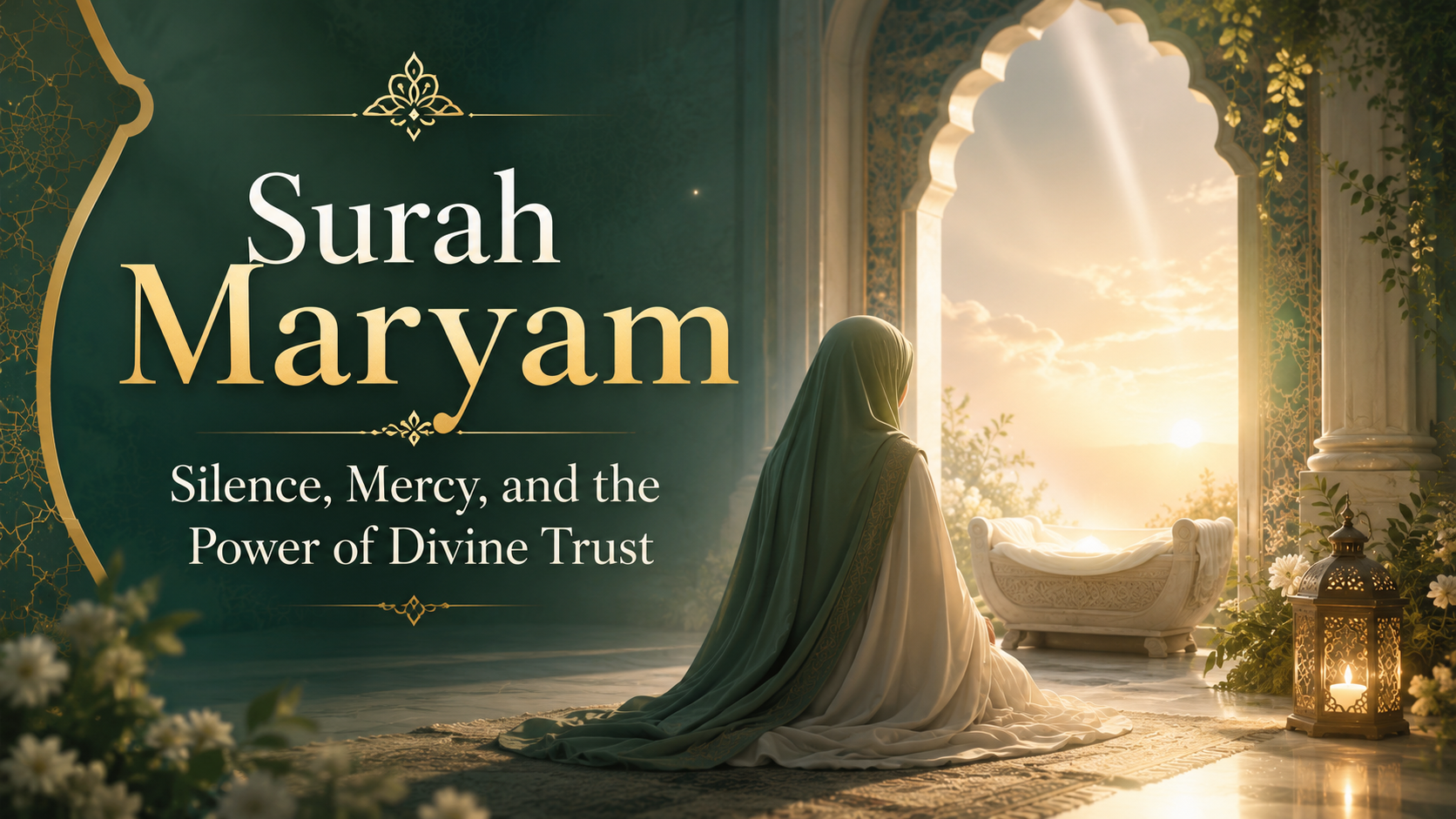
Surah Maryam is one of the most beautiful and spiritually rich chapters of the Qur’an. Every time I return to it, I feel that it opens a new door of meaning. Its language, rhythm, stories, and spiritual atmosphere invite us to pause, listen, and reflect deeply. This chapter is not only about Maryam, the mother of Prophet Isa, peace be upon them both; it is also about mercy, birth, silence, vulnerability, prophecy, and the possibility of new beginnings.
The story of Maryam holds a unique place in the Qur’an. She is the only woman mentioned by name, and an entire chapter is named after her. This alone invites us to ask why the Qur’an gives her such a central and honored position. Maryam is not presented as a marginal figure. She is placed in the sanctuary, chosen by God, purified, and entrusted with a mission that changes the direction of human history. At a time when women were often excluded from religious authority and sacred spaces, the Qur’an places a woman at the center of divine action.
Maryam’s story is not only the story of a miraculous birth. It is the story of carrying the Word of God. Through her, the Qur’an presents birth as something more than a biological event. Birth becomes a symbol of spiritual renewal, intellectual creativity, and divine possibility. Just as Adam represents the beginning of human creation, Isa ibn Maryam represents a new beginning in human history. The Qur’an compares Isa to Adam to remind us that God’s creative power is not limited by what human beings consider normal or possible.
The story also teaches us that new meanings often enter the world through pain, fear, and loneliness. Maryam carries a responsibility that no one else can carry for her. She experiences isolation, physical pain, emotional distress, and social accusation. Yet through this difficult experience, God brings forth mercy, guidance, and a sign for humanity. This is one of the great lessons of Surah Maryam: sometimes the most transformative gifts are born through moments of vulnerability.
One of the most powerful themes in Surah Maryam is silence. When Maryam returns to her people with the child, she is instructed not to speak. At first glance, this silence may seem difficult to understand. Why would she remain silent at the very moment when people are accusing her? But the silence of Maryam is not weakness. It is not surrender to oppression. It is a meaningful and active silence. She does not need to defend herself because the truth she carries will speak by God’s permission.
The newborn Isa speaks on her behalf. His words clear her, honor her, and announce his own prophetic mission. In this moment, the Qur’an teaches us that not every accusation deserves an immediate answer. Not every truth needs to be defended through argument. Sometimes, the work itself, the word itself, or the truth itself must be allowed to stand and speak. Maryam’s silence becomes an act of trust in God.
This silence can also be compared with the silence of Zakariya. When Zakariya is given the glad tidings of a son in old age, he is also given a period of silence. His silence comes after surprise at the divine promise, while Maryam’s silence comes as protection in the face of accusation. In both cases, silence becomes part of divine education. It quiets the noise of doubt, fear, and social pressure. It creates space for the miracle to unfold.
In our own lives, this lesson is deeply relevant. We live in a time when everyone feels pressured to respond, explain, defend, and react immediately. Silence is often seen as weakness, but Surah Maryam shows us that silence can be strength. Silence can be patience. Silence can be trust. Silence can protect the birth of something new. Every person who creates, writes, teaches, serves, or carries a responsibility needs moments of silence in order to allow meaning to mature.
Maryam’s experience also helps us understand the heavy responsibility of carrying a divine word. The Qur’an describes revelation as a “heavy word.” Prophet Muhammad, peace be upon him, also experienced the burden of revelation with deep emotional and physical intensity. In this sense, Maryam’s carrying of Isa and the Prophet’s carrying of revelation reflect a shared spiritual pattern: divine responsibility is beautiful, but it is never light. It requires surrender, patience, courage, and trust.
Surah Maryam also challenges narrow cultural ideas about women. The Qur’an does not present one single model of womanhood. Women in the Qur’an appear in many different roles: mothers, believers, rulers, protectors, questioners, wise women, vulnerable women, and women of courage. Maryam is not honored because she fits a cultural stereotype. She is honored because of her faith, purity, surrender, courage, and unique relationship with God.
The image of Maryam standing with her child before an accusing society is one of the most powerful images in the Qur’an. She stands in vulnerability, but that vulnerability carries divine strength. She does not possess worldly power, wealth, or social protection. Yet God makes her a sign. Her child speaks. Her truth becomes clear. Her story becomes eternal. This is the Qur’an’s way of redefining strength: true strength is not always loud, forceful, or dominant. Sometimes true strength appears as patience, tenderness, trust, and quiet courage.
Another central theme of Surah Maryam is mercy. The name Ar-Rahman, the Most Merciful, appears repeatedly throughout the chapter and gives it a special rhythm. The chapter begins with mercy shown to Zakariya and continues through stories of prophets who faced rejection, exile, and hardship. Yet the atmosphere of the Surah remains filled with divine compassion. Toward the end, the Qur’an promises that those who believe and do good deeds will receive love from the Most Merciful.
This promise of love is essential. Surah Maryam does not leave the human being alone in fear, pain, or responsibility. It reminds us that even though every soul must come to God individually, the path of faith is surrounded by divine mercy and love. The believer may carry a burden alone, but is never abandoned by God.
For me, Surah Maryam is an invitation to read the Qur’an with fresh eyes. It asks us to move beyond inherited assumptions and listen carefully to the voice of the text. It invites women, in particular, to see themselves not as outsiders to sacred meaning, but as full participants in reflection, interpretation, knowledge, and spiritual responsibility. Maryam’s story opens a door for rethinking prophecy, creativity, silence, motherhood, and the birth of new moral worlds.
In the end, Surah Maryam teaches us that God creates openings where human beings see impossibility. It teaches us that mercy can appear in unexpected forms. It teaches us that silence can be an action, vulnerability can be strength, and birth can be a sign of renewal. Above all, it teaches us to trust the Word of God and to allow truth, when carried sincerely, to speak in its own time.
© Copyright 2024, All Rights Reserved By ACNA